
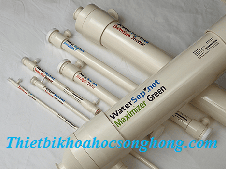
Cột lọc tiếp tuyến WaterSep được chế tạo bằng cách sử dụng màng lọc polyethersulfone (PES) tạo ra được màng lọc dạng sợi không đối xứng với đặc tính chống lỗi màng và đem lại công suất lớn.
.png)
CÔNG NGHỆ MÀNG LỌC WATERSEP 
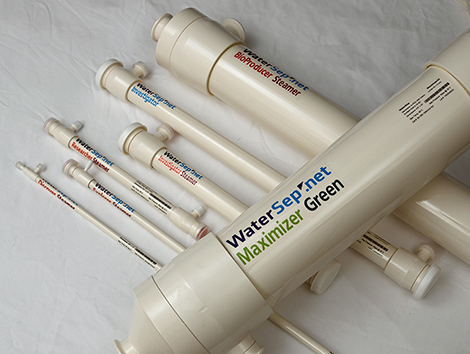

Công nghệ màng lọc WaterSep – Màng lọc dạng sợi không đối xứng, chống lỗi màng, công suất lớn.
Cột lọc tiếp tuyến WaterSep được chế tạo bằng cách sử dụng màng lọc polyethersulfone sửa đổi (PES) và quá trình quay phù hợp ở đó đã tạo ra được màng lọc dạng sợi không đối xứng với đặc tính chống lỗi màng và đem lại công suất lớn.
Các sản phẩm lọc tiếp tuyến dạng sợi của WaterSep có các điểm đặc trưng:
Các đặc điểm vượt trội
• Màng lọc polyethersulfone (PES) chống lỗi màng đáp ứng các quy định
• Cấu trúc chắc chắn giúp vận hành tin cậy bền vững
• Tối ưu hóa cho các ứng dụng cụ thể
Các ưu điểm vệ hiệu suất đã được kiểm chứng
• Lỗi màng thấp / Thiết kế chống điểm chết
• Lưu tốc cao / Dung tích lớn
• Dễ dàng tẩy rửa vệ sinh
• Tuổi thọ bền hơn / kinh tế hơn
WaterSep mang lại cho khách hàng:
Về vật liệu
Màng lọc của WaterSep’s được tạo ra từ một thiết kế đặc biệt, polyethersulfone (PES) chống lỗi màng, đưa ra các đặc tính về vật lý và hóa học đặc biệt. Vật liệu màng PES đáp ứng các yêu cầu quy định khắt khe nhất cho các quá trình sản xuất sản phẩm thực phẩm, sinh dược phẩm. Các đặc tính chống lỗi của màng lọc giúp cho màng lọc lý tưởng cho hầu hết các ứng dụng có liên quan đến lipids, chất béo, mỡ và dầu/nước cũng như các chất chống bọt thường được sử dụng trong các dịch lên men.
Về vận hành
WaterSep membranes have a unique void free structure, which is significantly stronger than competitive finger void membrane structures. This structure results in a stronger membrane with a longer service life and significantly lower risk for fiber breakage and product loss. The membrane also has a very high water and process permeability, resulting in higher process capacity and lower cost of ownership.
|
|
|
The above images show the difference between a traditional finger void membrane and WaterSep's void free matrix. The void free structure gives a mechanically stronger, more robust membrane with extended service life and reduced cost of ownership.
Hollow Fiber Membranes
The Right Format
Hollow fiber cartridges are a superior format for processing many food, beverage, biopharmaceutical, and industrial fluid streams. The open flow channels are ideal for clarification applications.
Our filters accommodate particle-loaded process streams with significant improvement over traditional cassette, plate and frame and spiral-wound cartridges. Rather than rely on retentate screens that risk particle entrapment WaterSep cartridges avoid dead spots with an open flow path—which also makes cleaning and sanitizing easier and more effective.
In addition, by design, WaterSep filters provide a straightforward scale-upprocess, going from laboratory volumes to pilot-scale to full manufacturing without a change in materials, fluid-path length, or performance characteristics.
The Right Choice
But even within hollow fiber technology, all products are not alike.
WaterSep offers you a proprietary membrane composition and design that you will appreciate after your first use.
Our membranes are created from a specially-designed PES material and optimized for specific applications by maximizing antifouling properties, product retention, and permeate flow rates.
These modification techniques – perfected after years of applied research in the field – result in measurable performance improvements.
Unmodified, competitive membranes have been known to foul in the presence of starches, oils, lipids, and other "sticky" substances. This leads to low flow rates and shorter service life. In an attempt to overcome these problems, many vendors suggest increasing the membrane area. The drawback of this approach becomes a need for larger systems and consequently higher processing costs.
Membrane Selection Guide
Finding the right membrane for your existing or potential application can be quickly accomplished by choosing among the options in a few key areas:
1. Material
2. Molecular Weight Cut-Off (MWCO) / Pore Size
3. Cartridge Length / Fluid Path
4. Membrane Area / Processing Volume
To view a complete selection of products, click here.
The following section discusses the importance of key characteristics.
General Guidelines for choosing a WaterSep Hollow Fiber cartridge

Material
All WaterSep membranes are based on industry accepted polyethersulfone (PES) materials. PES exhibits exceptional chemical and physical properties and has regulatory properties suitable for food products and biopharmaceutcal processing.
[ back to top ]

MWCO (a.k.a Pore Size or “Cut off”)
For a product concentration application the recommended membrane cut-off should be a factor 5-7 smaller than the smallest product molecule that should be retained by the membrane.
Example:
For a product molecule that has a molecular weight of 65,000 Dalton, a 10,000 Dalton membrane is recommended. The molecular cut-off standard for membranes is based on globular shaped molecules. A linear molecule of similar molecular weight typically requires a tighter membrane.
Similarly, for quantitative passage of a molecule through a membrane, the MWCO should be 8-10 times larger than the passing product’s molecular weight.
If a passage >95% is required, an additional diafiltration step is recommended.
[ back to top ]

Cartridge Length / Fluid Path
Shorter Cartridge Lengths (12” and 24”)
Advantages:
• Used when higher viscosity (>2,000 cps) solutions are processed. Shorter path lengths result in lower pressure drops, lower operating costs, and less product denaturation
• Used when length or height constraints exist or more compact processing is desired.
Disadvantage:
• Less efficient surface area to pumping capacity. Longer path lengths use similar feed flow rates as shorter lengths yet more surface area is employed
Longer Cartridge Lengths (41” and custom configurations)
Advantages:
• Used when low viscosity (<2,000 cps) solutions are processed. Longer path lengths use similar feed flow rates as shorter lengths yet more surface area is employed resulting in higher permeate rates.
• Used when length or height constraints are not a factor. The desired length when large scale processing is desired.
Disadvantage:
• Operating costs increase as a function of pressure drop. High pressure drops also add more heat to the process solution leading to potential product denaturation.
[ back to top ]

Membrane Area / Processing Volume
For membrane area determination, the average process flow rate and the volumetric throughput need to be considered. For a typical 8- hour work shift, a processing time of 3-5 hours is recommended followed by 1-2 hours of cleaning and sanitization.
Example:
To produce a batch size of 2000 liters in a 4-hour timeframe,
your target rate needs to be 500 liters per hour.
Membrane capacity is measured in liters/m2 and hour (LMH). With a flux of 40 LMH, the required membrane area is 12.5 m2. For this application, we recommend either: 3 Producer 41" cartridges or 6 Producer 24" cartridges.